Re-vision NOTICE:
October, 21, 2026
This is the beginning of a revised version of my original blog project (published
February 2026) which pays Homage to M.C. Escher & Mannerism.
This Introductory page contains a revised text and a revised
selection of images. The remainder of the prohect will
consist of several separated thematic parts.
Please watch for them on my blog's Welcome Page
over the next few weeks.
Steven D Foster
_________________________________________________________
Part 1 : Introduction
Homage to
M. C. Escher
And Robert Lutz's film:
M.C. Escher ~ Journey To Infinity
&
Waldemar Januszczak's film:
"MANNERISM"
Art's Wildest Movement
(1520-1590)
~This is an Inkjet Print Project~

Click on the image twice to enlarge
Welcome to my new revised blog project,
a "Wonder Room" filled with
Many Photographic Curiosities!
Introduction
I'm writing this revised version of the Introduction to my Escher-Mannerism Homage project in mid October, 2026. A revised selection of images will be included. The project was inspired by a synchronistic falling together in time involving the seeing of two film-videos (on Amazon.com) within days of each other: Art Historian, Waldemar Januszczak's three-part film: Art's Wildest Movement: MANNERISM 1520-1590 and Robin Lutz's excellent film, M.C. Escher ~ Journey to Infinity The two experiences sparked an wild response in me and my Creative Process, quite appropriate--I believe--given the content in both very stumulating films.
The first version of this project was, it is clear to me now, was merely a first attempt at putting a huge number of ideas together along with way to many images despite my feeling free to create a Mannerist "Wonder Room" filled with "Curious" or "Wild" or "Quirky" or Odd", "Strange" or "inventive" images that were inspired by the project and the many themes that the new project will address. All of the images you will see now exist as part of my 2023-2026 Inkjet Print Project. I 155 images in the early version of the project, of which 88 were drawn from my pre-existing collection of Inkjet Prints, and the remainder 67 (of the 155 images) were constructed and (or) printed specifically in response to this project.
My response to MC Escher--his life and his work--for the most part deal with Perceptual ambiguity, Image Repetition, Symmetry, and the concepts of Unity, Infinity or what Escher often referred to as "Endlessness . . ." But I feel that much of Escher's work has been misunderstood and I hope my position throughs some additional light on his work.
At the conclusion of Januszczak's 3-part film on Mannerism he stated:
Mannerism had many faces. [Some perverse but also some sublime.] . . . Mannerism "did" many things: it did "fear" and "love", "anger" and "religion," "mythology" and "sex." And it did all of them in new ways . . . It jumped so happily from medium to medium . . . and from small to very large [for example from jewelry to sculpture to architecture] . . . Was there ever an art movement that achieved as much on as many fronts as Mannerism? No, I don't think so.
This statement made me consider my entire creative output over the past 50 years, and indeed many of the images in this project are from my various "periods" of work, including photographs I made when I was an undergraduate student at RIT in Rochester, NY (1963-66), in Chicago (1967-68) New York City (1968 & 69), New Mexico (1969-72), Atlanta (1972-75), Milwaukee (1975-2007) and Canandaigua, NY (2008-the present time, 2026).
In this first part of the project as a whole, I am focusing on my visual response to Escher's work, and in my text I am responding to aspects of his life that seems synchronistically to parallel many things I have experienced. So this project is for me both a continued journey into my love of visual transformation and as well what Escher often explored in his work such as Perceptual ambiguity, Image Repetition, Symmetry, and the concepts of Unity and Infinity.
I have draw images from previous photo projects included in my Thematic collections of Blog projects such as my Faint Photographs, my Line Drawing on Photographic Images series, my out-of-focus and blurred series; my Thing-Centered photographs, my Garage series; my collections of human figures and Portraits, Still Lifes, Abstract photos, Sacred Art Projects, and many of my Homage projects. I have included new transformed versions of older blog published images in this project and all of them have be made into inkjet prints.
I had seen the Journey to Infinity a few years ago and purchased the streaming version from Amazon Prime, and decided to watch it again after I included two pictures in my last completed blog project, Humor: a straight photograph of a concrete stairs (that I presented upside down), and two symmetrical versions of that image, both of which reminded me of the many popular images MC Escher had made of impossible and infinitely unfolding & circling back stair steps. (the images can be see below: Images #1A, #1B, #1C and the project's Title Image, above)
Immediately after I finished watching Journey to Infinity I saw a notice from Amazon.com informing me they had just added Januszcsak's new 3-part video on Mannerism to their website. I have been a fan of Januszcsak's videos for many years, and have seen all his videos offered on Amazon's website. So I immediately watched the three Mannerism videos. Over the next few days, as I began to process more consciously how much the two video experiences meant to me as a "meaningful coincidence," what CG Jung referred to as Synchronicity, they seemed to merge together in my mind in a way that suggested to me there is a new photography project waiting for my concentrated attention!
*
Synchronicity, a concept that Carl Jung--the "Father" of modern depth psychology--had explored late in his life--and became for me a dominate theme in my 1972 required MFA written thesis at the University of New Mexico, Albuquerque. A friend had gotten me interested in Jung's work on Medieval Alchemy, visual archetypes, the symbol, and the structure of the human psyche. It all made sense to me in relation to my fascination with the photographers Alfred Stieglitz & Edward Weston had made and written about. Jung's ideas about the Creative Unconscious, and a Unified psyche--which he termed the Self--eventually became the focus of my Written Thesis: The Symbolic Photograph A Means to Self Knowledge.
So, here, once again, synchronicity has directed me to a new project about which I knew consciously very little about. As I researched M.C. Escher's life and work it became quite clear that there were remarkable parallel life experiences and picture making ideas that we shared.
*
In the last ten days of January 2026, when I began working on this project, I was also being horrified by the news reports of a second innocent civilian being violently attacked and murdered--shot dead, multiple times--by federal agents. Two needless and unforgivable killings in less than two weeks!!! The news and images that were being shown and written about each and every day, about how the most vulnerable and innocent people are being attacked, and then badly damaged physically and emotionally, and placed in horrifying detention centers, operated under the most mean-hearted conditions, including separating family members from each other, and even children being separated from their mothers . . . all of which was being initiated by our own Federal Government . . . . . . .
It had by then become quite obvious that I was experiencing something I never ever thought I would be witnessing: Fascism has indeed infiltrated the Federal Government of the USA. And just recently it has come to light that our president has, without congress's approval, begun supporting Russia, and enabling the killing of the citizens of Ukraine.
This project, then, has been for me both a kind of refuge . . . and at the same time a way to give voice (visually and in words) to my feelings in ways I had never before felt would be appropriate, possible or necessary in my work. And importantly, I began to understand how what has happened in the period 2024-2026 in the US has helped me to better appreciate the life and work of M. C. Escher (1898-1972) who had himself experienced--multiple times--similar situations in his life.
Regarding M.C. Escher
Robin Lutz's film, M.C. Escher ~ Journey to Infinity (released in 2021) provided me with a deeper and more personal way to appreciate the life Escher lived, the ideals he pursued, the deep love he felt for his wife Jetta who suffered sever depression because of her civilian experience of Fascism in multiple places she had lived, including Italy, where she met Escher, and his attraction to Islamic Art, a love which I share with him after I visited Turkey and Spain seeking out Islamic sacred art. Escher, like me, too refuge in his art work from a terrifying world.
Lutz's film brings Esher's work quite literally to life with the use of animation--something Esher himself wrote about and expressed a great interest in. Escher believed it would be the ideal medium for the kind of ideas that he explored throughout his life as a printmaker. And the film clearly explains (visually and in Escher's own words) his deep fasciation with the overwhelming number of non-figurative, interlocking-repeating geometric and floral patterns that pervades the great Alhambra, in Granada, Spain, images which in most cases were intended to celebrate the sacred Islamic idea of the Infinite. His love of Islamic Art began to blossom for him when he first visited the Alhambra in 1922
. . . followed by a second visit in 1936 with his wife Jetta.
I also share Escher's fascination with Perceptual ambiguity, Image Repetition, Symmetry, and the concepts of Unity, Infinity and what he termed "Endlessness." Above all, Escher was interested in connecting and transforming things into unified visual fields; or, said in another way, "closing the circle." Escher made several images involving the mobius loop.
My obsession with the "True living Symbol" relates directly to Escher's need to unite things. My MFA Written Thesis was based in the Jungian ideas that everything in our dualistic world originates from the inner-world of the mind or psyche. And Jung's idea that True Symbols are images which unite or conjoin inner psychic images with their outer-world physical counterparts is something I had often consciously experienced in spontaneous synchronistic moments of recognition related to my creative process in photographic picture making. As I worked on my MFA thesis, the depth of the impact of the Creative Unconscious and the concept of synchronicity on my creative process in photography became surprisingly clear and all the more personally meaningful to me.
(Visit my blog essay regarding my experience of Seeing the Grand Canyon which is very much about synchronicty and the yogic take on how the outer world relates directly to the inner world. I began studying and practicing Siddha Yoga in August, 1987 after meeting Gurumayi Chidvilasananda, and experiencing her grace in a very intense way.)
Lutz's film Journey to Infinity gives an intimate account of how Escher moved through the world as an introverted artist with the many personal challenges he had been faced with throughout his life, often because of the horrors associated with politics and Wars, from which he had been forced to escape several times in his life.
Escher's lithograph Bond of Union (see below), a 1956 portrait of himself and his wife Jetta, reveals an almost cosmic-transcendent connection he had experienced with her. It is literally an image of his psychic Union with a woman who had suffered severe mental health problems, most probably beginning with her family's forced departure from Russia to Finland in 1917 (when Jetta was 19 years old) because of the Russian Revolution. In 1922 (when Jetta was around 23 years old, and still living in Finland) she and her family moved to Italy after experiencing near starvation and witnessing the slaughter of people that she had become very close to.
Escher had moved to Italy at about the same time. He met Jetta in Italy, and although she was very pretty, we can see in the snapshots made of Jetta at that time, she appears emaciated and noticeably sad or depressed.
Escher fell madly in love with Jetta and they married in Italy in 1924. They lived a relatively happily life together in Italy for the next eleven years until the growing oppression of Mussolini's rule forced them to leave Italy and move to Switzerland in 1935. Then, in 1941 Escher and Jetta moved to the Netherlands due to the rising pressures of World War II.
Esher and Jetta separated in 1968 probably due to Jetta's depression and a growing feeling of loneliness which was in part probably due to Escher's introverted nature and his need to take refuge in his art work from the horrors of war. Jetta moved to Switzerland to live with their youngest son. She died there in 1987 at the age of ninety. Escher died in 1972 at the age of seventy-three . (To learn more about Escher visit this article "The Hidden emotions in Escher's work.")
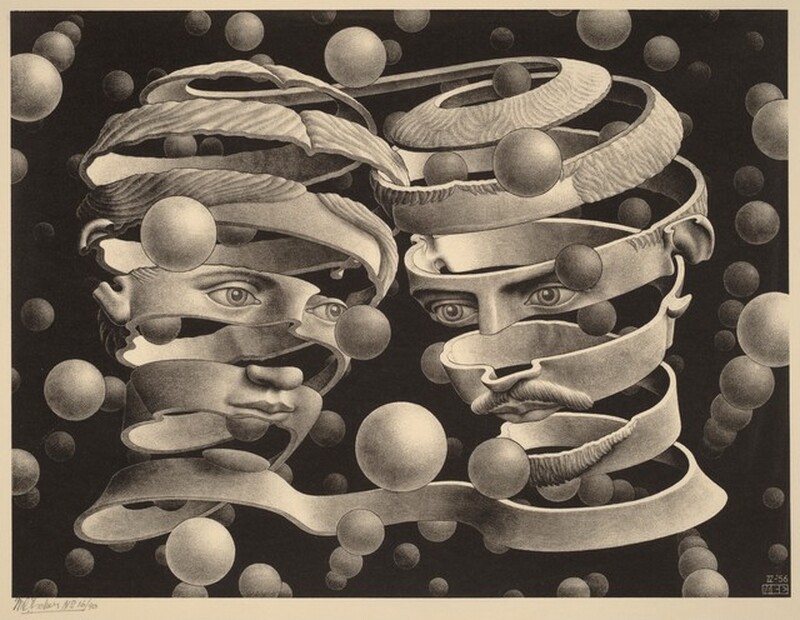
Escher Bond of Union 1956 Lithograph
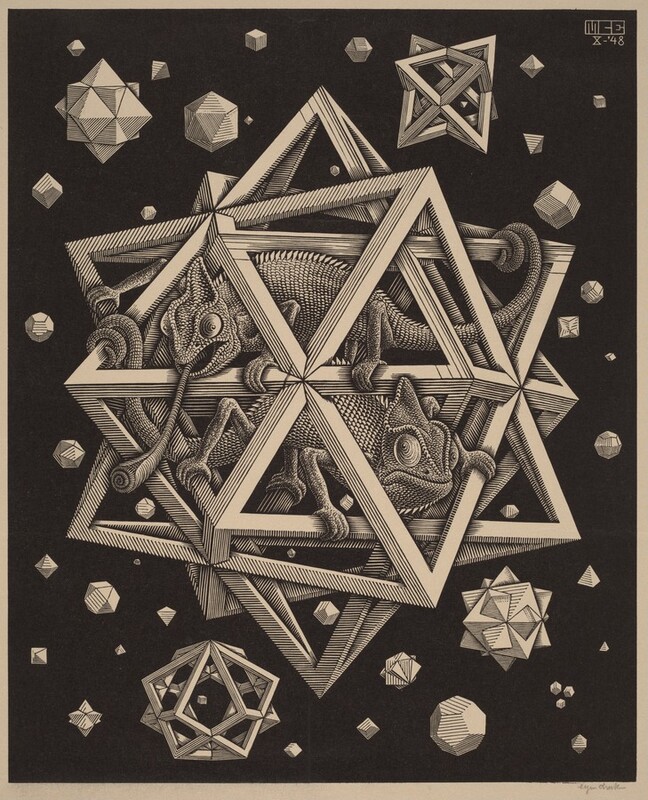
Escher "Stars" 1948 Woodcut
Esher's 1948 woodcut (above) entitled Stars is related to Bond of Union in the way that the two images conjoin opposites: male-female in Bond; the mythic/alchemical Lizard-like natural forms bound up in mathematical-geometrical forms in his woodcut, Stars). Also, in both images everything is suspended in dark cosmic space . . . with an infinite number of different sized balls in Bond of Union and different sized geometrical shapes in Stars. (Are the balls and geometrical forms atoms? planets? worlds? Escher liked to think of himself as a designer, a "mathematician" . . . even a scientist, but never an artist. He often pursued commercial work as a graphic artist when money was needed to care for his wife Jetta and his two children.)
Regarding Escher's many works dealing with the metamorphosis of one image into another, and his particular interest in stairways . . . the 1953 lithograph entitled "Relativity" (below) tests our ability to remain aware of what is spatially, ambiguously, impossibly unfolding before our eyes while--at the same time--our brain and our "eyeballs" are being tricked (and perhaps agitated) by Escher's irrational, puzzling, complex space-time imagery.
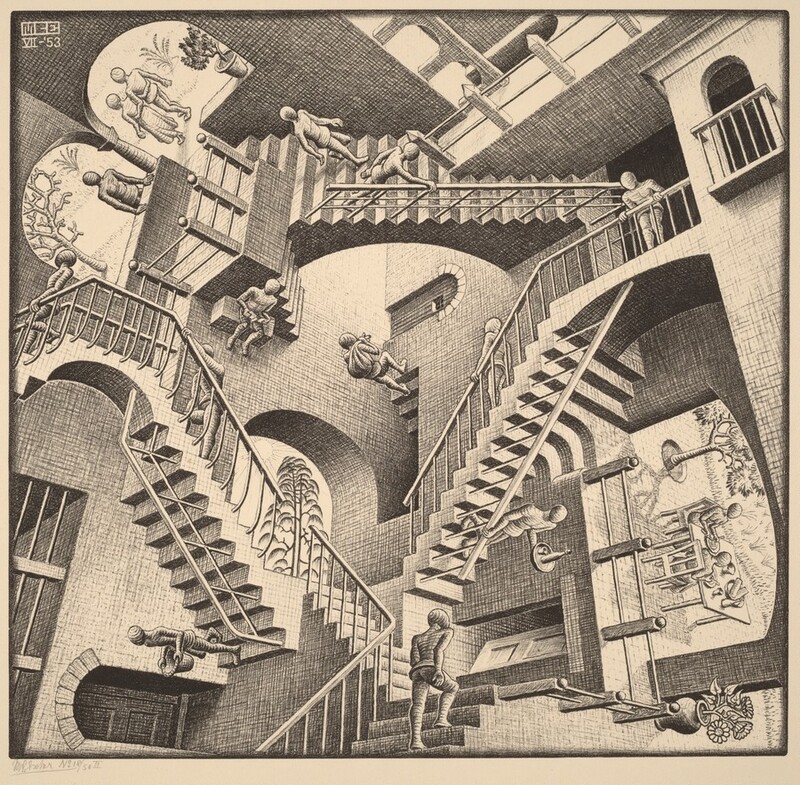
Escher "Relativity" 1953 Lithograph
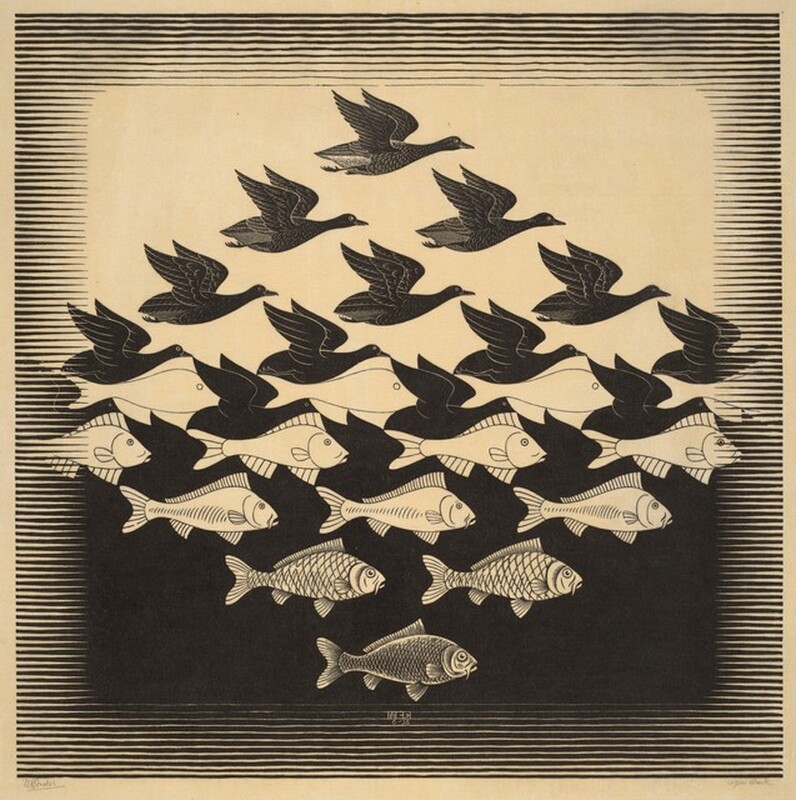
Escher "Sky and Water I" 1938 Woodcut
Regarding my own Creative Process
If you are not familiar with my past work, I invite you to visit my two blog projects Triadic Memories and "An Imaginary Book" which explore many of the same kinds of visual issues which interested Escher.
In Triadic Memories (2003-007) I became fascinated with image repetition. In some pieces I present the viewer with various kinds of ambiguous perceptual challenges which Escher also pursued constantly throughout his life, as in his 1953 lithograph "Relativity," and his 1938 woodcut of transforming birds in the sky and fish in water entitled "Sky and Water I" (immediately above).
I particularly like Escher's "Sky and Water" for it's simple, elegant, graphic symmetrical organization, its tonal inversions and subject matter transformations (i.e., the dark birds against a light ground transforming into light fish against a dark ground) all of which happens before our eyes simultaneously. I too use tonal inversions frequently in my work and you will see several examples of that in the collection of photographs I have presented in this multi-part project.
In my multi-chaptered project "An Imaginary Book" (2011-13) I explore image repetition mostly in the form of four-fold symmetrical imagery, but also in a formal experiment in which I explored fields of repeating images inspired by a musical concept--the Chromatic Field which American Composer Morton Feldman came up with and realized in a wonderful composition for solo piano entitled Triadic Memories.
Also, like Escher, I too had became fascinated with image repetition in Islamic Art. When my wife Gloria and I visited Turkey in 2011 for two weeks I not only saw but also experienced, epiphanically, very intense encounters with the mysteries of Islamic Sacred Art. The experiences inspired me to begin making my very first symmetrical photographs which I published in "An Imaginary Book."
I devoted the entire year after my visit to Turkey researching the theme Sacred Art, in general. But I pretty quickly focused on Islamic Sacred Art which I felt a strong affinity to as I read more and more about it. My research Islamic art then ignited a strong desire in me to visit Spain, which of course was the home of the great Mannerist El Greco, and the home of the Alhambra, which Escher visited twice, and the Great Mosque of Cordoba which I had read so much about in my research.
"An Imaginary Book" became my first project in a long series of projects which were to become essentially a contemplation on the symmetrical image and the idea of Sacred Art within a contemporary art practice. (See my hyperlinked listing of Sacred Art Photography Projects.)
*
My interest in Sacred Art in 2012 did not just come out of the clear blue sky. In my first three years of college in the Photo Program at RIT (in Rochester, NY 1963-66) I fell in love with the photographs, ideas and stories I heard and read about in the work and lives of Alfred Stieglitz and Edward Weston. I was impressed with Stieglitz's ideas about how a photograph could embody the feelings of the photographer, and Weston's ideas about how photographs could unveil the essential nature--the life force--which pervaded objects. Every week, after attending my History of Photography lectures by Beaumont Newhall at the George Eastman House Museum of Photography, I would visit the display of Modernest photographs on the second floor, and in particular I would always visit Steiglitz's cloud photographs and Weston's photographs of Peppers and Shells.
Siddha Yoga & Symbolic Photographs
Carl Jung's ideas which were central to my MFA written thesis, and the idea of the Symbolic Photograph were the dominant focus of my photography between 1972 and 1987.
However, in 1987 Gloria and I were invited (by one of Gloria's sisters) to take a two-day yoga meditation program with Gurumayi Chivilasananda at her ashram in NY State. On the second day of the meditation program I had a very intense, visceral experience of Gurumayi's grace, the sacred energy that pervades the Inner divine Self which--as Gurumayi teaches--dwells in the Heart of every human being and pervades every created thing. I was overwhelmed by my experience of feelings, of a divine presence, that emerged from deep within my heart and then washed over me again and again--like waves upon waves of love that had been released from within my own Self. I later understood that I had been given a glimpse of the yogic teaching often referred to as the Oneness of Being, a concept I then began to apply to idea of the True, living Symbolic Photograph.
Immediately after the intensive I began to meditate and study the teachings of the Siddha Yoga Masters on a daily basis. In a very natural way this led to the integration of my practices of Siddha Yoga with my practice of photographic picture-making. The desire to make Symbolic Photographs which was first based in the ideas I had written about in my 1972 MFA written thesis, eventually merged with the yogic teachings and experiences I was absorbing through my practice of Siddha Yoga. I came to understand that True, living Symbols are pervaded by a subtle radiance, and an unknowable kind of meaning that had more to do with the grace of my Creative Process and much less--or most probably, nothing--to do with my intellect or ego.
A Symbolic Photograph is, for me, a sacred image alive with grace that has emerged from within in me, a conjunction of an inner-world psychic image with its outer-world physical visual corresponding counterpart. In other world is is an image which gives visual form to a meaning beyond saying, beyond knowing. Making True living Symbols, images which are radiant with an interior light which I attribute to the grace of my Creative Process, is important to me . . . beyond words. Making Symbolic Photographs helps me to remain connected to the grace of my yogic practices and it helps me to live more consciously aware of the infinite ways grace pervades all aspects of my life and all the created things in this world.
Regarding the Two Parts of this Project
PART ONE
_____________
I decided to present my photographs for this project in two collections: the FIRST PART presents only my Symmetrical photographs, for in fairly obvious ways they relate most directly to Escher's love of image repetition, symmetry, and the concepts of Unity, endlessness . . . the Infinite.
My symmetrical photographs are--in the most literal sense--images which give form to the idea of the Oneness of Being for they are image constructions consisting usually of four identical images conjoined above & below, and left & right--in a way that manifests a unified visual field where all four images meet at the very center point of the image.
The symmetrical photographs often become filled with surprising and wonderful visual transformations. However, to be clear: when I say the symmetrical photographs are quite literally images about the Oneness of Being, they should not be understood to necessarily be functioning as True, living Symbols.
If a symmetrical image I have made does not radiate a subtle kind of interior light for me, or a feeling that I can attribute to the grace of my Creative Process . . . I most probably will not publish the image on my blog. Some symmetrical images may have value for me even if they do not function for me as True living Symbols, and sometimes the visual drama in an image may temporarily blind me to their shallow titillations, but my ultimate goal as a visual artist--and as a student of yoga--is to make symmetrical images (and straight photographic images as well) which have a sacred or divine presence, or a radiance of grace. It is grace, and nothing else, which transforms a photographic image into that which functions for me as a True living Symbol.
*
I do sense a spiritual presence in some of Escher's works, but I'm not aware that Escher ever saw or considered his work in that way. I do find his lithograph entitled Bond of Union a very powerful, mysterious and heartfelt image, and yet I suspect Escher would find it very difficult to talk about the image in those terms.
(I can't help but wonder if Escher's interest in the Islamic work he saw in the Alhambra (twice in his life) was in part due to an unconscious or intuitive identification with the great spiritual traditions of Islam and its Sacred Art which, I believe, to some degree he did become awakened to during his two visits to the Alhambra.)
*
I had first discovered the power of repeating image patterns in my own work while making Chromatic Fields (and other forms of repeating images) for my multi-part project Triadic Memories (2002-07). I had become inspired by the contemporary music of American composer Morton Feldman, music that involved repeating patterns of notes suspended in silence, a musical space in which the composer would allow the sounds he made on the piano-- often with the sustaining pedal held to the ground--to dissolve back into silence. Feldman was quite open about the fact that his music was inspired by his love of Turkish rugs which he had been collecting and studying for many years.
My 2002-2007 Chromatic Fields are directly related to the symmetrical photographs I later began making after I traveled to Turkey in 2011. Part of the reason I wanted to go to Turkey was my hope that by experiencing the place where the very best ancient, Turkish rugs were made, I would somehow better understand Feldman's music.
Indeed, when I visited the amazing Turkish and Islamic Art Museum in Istanbul, which had the most wonderful displays of original, ancient Turkish and Islamic carpets, and illuminated Qur'ans, I was indeed very impressed by the carpets . . . But, I was even more impressed by the illuminated Qur'ans I saw. One in particular set me off into an unforgettable inner experience of light that appeared to pervade the entire page of the opened Qur'an. (I have written in detail about many of my experiences in Turky of Islamic Sacred Art in the first chapter of my "Imaginary Book" entitled Prayer Stones.)
*
As I became experienced in the process of creating Chromatic Field images, I learned, as did Escher, that it was much more practical and efficient to create pattern fragments which could then be easily connected together into larger visual fields that could suggest or serve as a metaphor for a never-ending, Infinite unfolding of transforming patterns. In the film Journey to Infinity we are given the remarkable opportunity to see animated versions of some of Escher's prints; an imaginal journey that Esher wrote about in relation to one of his images; and even some documentary footage of Escher at work using this technique of image fragments to create his late, very special 1969 woodcut print entitled Snakes:
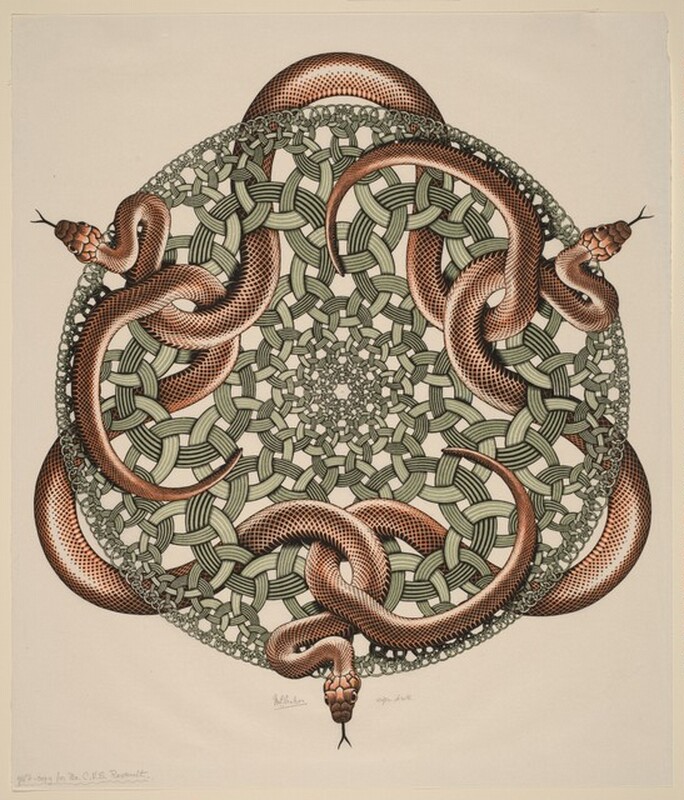
M.C. Escher "Snakes" 1969 Woodcut print
This circular, symmetrical image of infinitely repeating motifs--an image which originates from its own center point . . . and then expands outwardly . . . relates in some obvious ways to the 1956 Bond of Union lithograph. And the archetypal imagery of snakes in this work is especially meaningful to me--or probably anyone who has studied alchemy or is familiar with the many yogic paths being practiced today, for the snake represents in those traditions sacred, purifying, creative-transforming energy.
In certain yogic traditions, that energy is known as Kundalini Shakti, which is said to lay dormant (and coiled-up, like a snake) near the base of the spine--in every human being. It remains dormant until it is awakened only by grace (in very mysterious ineffable ways). Once awakened . . . this divine transforming energy embarks upon a vertical journey of transformation along the path of the spine, purifying the many subtle energy centers, called chakras, along the way. Its destination is reached when it merges its sacred energy with the uppermost chakra located in the top part of the head.
The yogic practices (especially meditation) and the initiating grace of a Meditation Master are the primary means by which one's Kundalini energy can become awakened. My yogic practices combined with my photographic practice definitely helps me stay in touch with the grace that pervades and directs my Creative Process.
In the yoga I practice, the teachings say that realization of the Oneness of Being is achieved when the inner divine Self--which is said to exists in every Human Heart--merges with the yogi's mind. Carl Jung's concept of a Unified Psyche (which he sometimes called the Self) was very similar to the yogic idea of the Self.
Escher's image Snakes could be interpreted or even experienced by some as a spiritual, uniting Symbol. The image literally represents the phenomena of an awakening of the spiritual-creative Kundalini energy (the snake) which emerges from the infinitely small point at the very center of the image and then expands outward and upward . . . until finally the snake merges (intertwining) with Itself.
Many of Escher's metamorphosing works . . which are often mesmerizing and magical images to contemplate . . . are for me beautiful visual metaphors for the concept: The Oneness of Being.
*
I have a wonderful quote to share with you, by Keith Critchlow, author of the book entitled Islamic Patterns An Analytical and Cosmological Approach. The quote addresses many of the terms and concepts that I have been writing about, including the "inner Self" . . . "the point" . . . "unity". . . "eternity" . . . "a subject grounded in mystery" . . . "mathematics" . . . "circles" . . . "being" and more. Here is the quote by Keith Critchlow:
Islam’s concentration on geometric patterns [which are based upon mathematical laws of repetition] draws attention away from the representational world to one of pure forms, poised tensions and dynamic equilibrium, giving structural insight into the workings of the inner self and their reflection in the universe.
The circle is the archetypal governing basis for all the geometric shapes that unfold within it . . . reflecting the unity of its original source, the point, the simple, self-evident origin of geometry and a subject grounded in mystery.
The circle has always been regarded as a symbol of eternity, without beginning and without end, just being . . . In the effort to trace origins in creation, the direction is not backwards but inwards.
*
Regarding the Circle archetype: you will probably notice that there are lots of circles in the photographs I have included in this project, both in the collections of symmetrical images and the "straight images" (in Part Two). I have often referred to my symmetrical images as "circular" (or round) images. And, I have even understood--in certain moments of lucidity--that the square format--which I use most of the time in my work--is a "circular" or "round" format. I could go on and on about circles . . . but in short, the circle is a visual necessity in my work, and it has been for many years. With the introduction of the symmetrical image in my Creative Process, after my visit to Turkey, the circle motif has truly blossomed .
*
I want to conclude this first part of my project, with two additional quotes: the first one is by Escher that was used at the very end of the film M.C. Escher ~ Journey to Infinity:
I pursue a vision that cannot be realized. My prints that were made with the primary aim of making something beautiful, simply cause me headaches. That is why I never feel fully at home amongst my [artist] colleagues. They pursue beauty first and foremost. Perhaps I only pursue wonder.
The second related quote is by Januszczak which he uses at the beginning of each of the three parts of his video series Art's Wildest Movement: MANNERISM:
"Between 1520 and 1590 a new movement appeared in art.
It produced art that was strange, wild and inventive.
And it filled the world with wonders"
* * *
* * *
A brief note regarding "How to Best View My Blog-Published Images"
If you are viewing this project on a desktop computer or a laptop, I encourage you to click on the images once, then once again; this hopefully will enlarge the image and present it in a dark tonal alternative viewing environment at its maximum viewing quality in terms of image sharpness, luminance, tonal gradations, etc. You can then use your zoom-in & zoom-out options to adjust the image size, and you can darken or lighten the screen brightness with keyboard controls (or file menu options) to suite your particular viewing preferences in relation to your computer. For a further explanation, or if clicking on the images don't place you in the alternate viewing space, please visit this blog page for additional technical information and options: How to Best View My Online Blog Project Images
Additional information:
Each image in the project exists as an inkjet print made with the highest quality paper and inks. ~ The size of the print is given under the image on the far right side. Some images exist in several sized prints ~ And each image has an I.D. # which I have placed under the far left side of image. However, please don't concern yourself with their numerical progression, as it is often broken due to editorial decisions I have made in the process of changing or adding images within the vertical sequence of the two collections of images. ~ Photographs that were created and printed new and specifically for this project has the letter N preceding the ID number; and Images that were made and printed prior to the creation of this project will have the letter P preceding the ID number. ~ I have provided a title for each image on the second line beneath the image, in "Italics and in quotation marks" and I have--when it seemed necessary or helpful--included some commentary under selected images and provided links to some of my other related projects. ~ Welcome to the project. SF
Part One:
Photographs
inspired by
MC Escher
________________________________________

Homage Escher & Mannerism P#1A Inkjet print, straight photograph 12x12"
"Upside-down stairs"
(a straight photograph turned upside down)
This straight photograph, from my early
served as the Source image for the symmetrical variation below #1B. Most of
the black and white images you will see in this project have come from the 1994-2000 project.
It was the image above (#1A) which initiated the idea for this entire project, in mid-December, 2025 shortly after
I had watched--again--the excellent film: MC Escher - Journey to Infinity which I had purchased on
Amazon.com after seeing it the first time in October, 2023.
The image above (#1A) and the image below (#1B) were published in early December, 20205 in my Humor
12x12" Inkjet Print blog project simply because they reminded me of MC Escher's black and white prints.
Though the images are not so humorous, they did bring a smile upon my face when I studied them
closely. I remain charmed by the perceptual surprise they both quietly present--the way they
appear to be simultaneously "up right" and "upside down." I find myself going up &
down & all around in circles in the symmetrical image. These two images have
sparked all the new photographs you will seeing in this project.
Homage Escher & Mannerism N#1B Symmetrical Photograph 15x15"
"Circular Upside-down Staircase . . .
Infinitely ascending and descending"
Note: if your were looking at this image in print form, I would invite you to
turn it sideways and see it that way . . . as well as the way you see it here.

Homage Escher & Mannerism N#1C Symmetrical Photograph Variation 2 15x15"
"Circular Upside-down Staircase . . .
Infinitely ascending and descending"
ThisImage is N#1B (above) rotated 90 degrees manifesting a very different space. 
"Transformed Cement Bridge Structure"

Homage Escher & Mannerism N#2 Symmetrical Photograph 18x18"
"Transformation by Light & shadow streaking stacks of wood pallets"
This photograph is a mystery, for me. When I came upon the digital file I
had made of its source image--made originally on black and white film--
it excited me and I knew immediately that it would make a
strong symmetrical image for this project. The stacks of
light & shadow streaked wood pallets reminded
me of a favorite Escher woodcut prints I had
seen in one of four books I owned. I
have not been about to find that published image!

Homage Escher & Mannerism P#5 Symmetrical Photograph 15x15"
"Circular Constellations of stars suspended in infinite space"

"Young boys looking down into the Universe"

Homage Escher & Mannerism N#62 Symmetrical Photograph 18x18"
"Ice Fingers pointing toward cracks in the frozen meadow pond"

Homage Escher & Mannerism P#31 Symmetrical Photograph 15x15"
"Dancing tree shadows"

Homage Escher & Mannerism N#8 Symmetrical Photograph 15x15"
"Fishing Poles & lines suspended over circling waters"

Homage Escher & Mannerism N#9 Symmetrical Photograph 15x15"
"Dogs running up & down and upside-down on the sand dunes "

Homage Escher & Mannerism N#10 Symmetrical Photograph 15x15"
"Shadow of a Truck with eight metal-rimed tires inside it"

Homage Escher & Mannerism N#65 Symmetrical Photograph 18x18"
"Black and White Birds Flying in a Positive / Negative Grid formation"

Homage Escher & Mannerism N#21 Symmetrical Photograph 18x18"
"Meadow Community's houses in the fog--viewed from inside the meadow"

"Four Suspended Blue Birds"

Homage Escher & Mannerism N#40 Symmetrical Photograph 18x18"
"Sea Lions swimming in the light"

Homage Escher & Mannerism N#67 Symmetrical Photograph 18x18"
"Pink Goldfish in a light blue pond"

Homage Escher & Mannerism P#120 Symmetrical Photograph 21x21"
"Niagara Falls: Ball of water with two masked figures"
Visit my project: Falling Water

Homage Escher & Mannerism P#90 Symmetrical Photographs 21x21"
"How tall is this water falls?"
(A miniature water garden in the Alhambra, in Granada, Spain)
There are four repeated waterfall images in this four-fold symmetrical photograph.
As I remember it, the falls was about12-18" high.

"The South Meadow - Suspended in the light of an Orange Sunset with some blue clouded sky"

Homage Escher & Mannerism N#54 Symmetrical Photograph 18x18"
"Illuminated still life inside a shadow"

Homage Escher & Mannerism P#50 Symmetrical Photograph 18x18"
"Bedside Lamp and two large lampshade shadows"

Homage Escher & Mannerism P#49 Symmetrical Photograph 15x15"
"Double conjoined Chandeliers with dimmed lights"

"A Ceramic Bowl, opening, revealing its interior light"

Homage Escher & Mannerism N#71 Symmetrical Photograph 18x18"
"Two Stones thinking about each other"

"Symmetrical Child's Drawing with Blue Tape"

Homage Escher & Mannerism P#114 Inkjet Print - Photograph 18x18
Abstract Portrait: ". . . of a Constantly Talking Liar"

Homage to Escher N#15 Symmetrical Photograph 15x15"
"Our Children Reaching-For & Holding-Up The Big Ball (EARTH)"

"Waving Goodbye? or Welcoming Best Friends and Loved Ones?"
* * *
This Inkjet Print Project was first published and
announced on my blog's Welcome Page
February 15, 2026
Image Editing occurred October 15, 2026
More changes are forthcoming.
Related Project Links
My Complete list of Homage Projects which includes my projects on Monk & Steve Lacy
The 1994-2000 Studies Project and many other Studies Projects
The Persephone Series 1975-76 / 2011
Symmetrical Photographs ~ Images, Projects, Texts: click here
Photography and Yoga 2016
The True living Symbol click here
The Symbolic Photograph click here
Contemplating Symbolic Photographs click here
Welcome Page to The Departing Landscape blog-website which includes the complete hyperlinked listing of my online photography projects dating back to the 1960's, my resume, contact information, and more.
54 ~ the number of New Photos made for this project which includes in total about 155 photos
.
